Pipes rarely burst without warning. In the hours or days before a failure — especially during a La Crosse cold snap — your plumbing usually sends signals: strange sounds, odd smells, pressure changes, visible frost. Most homeowners notice these signs and file them under "I'll look at that later." Later is often a flooded basement. Here are the seven warning signs that your pipes are about to burst, what each one means, and what to do when you spot it.
1. Frost on Exposed Pipes
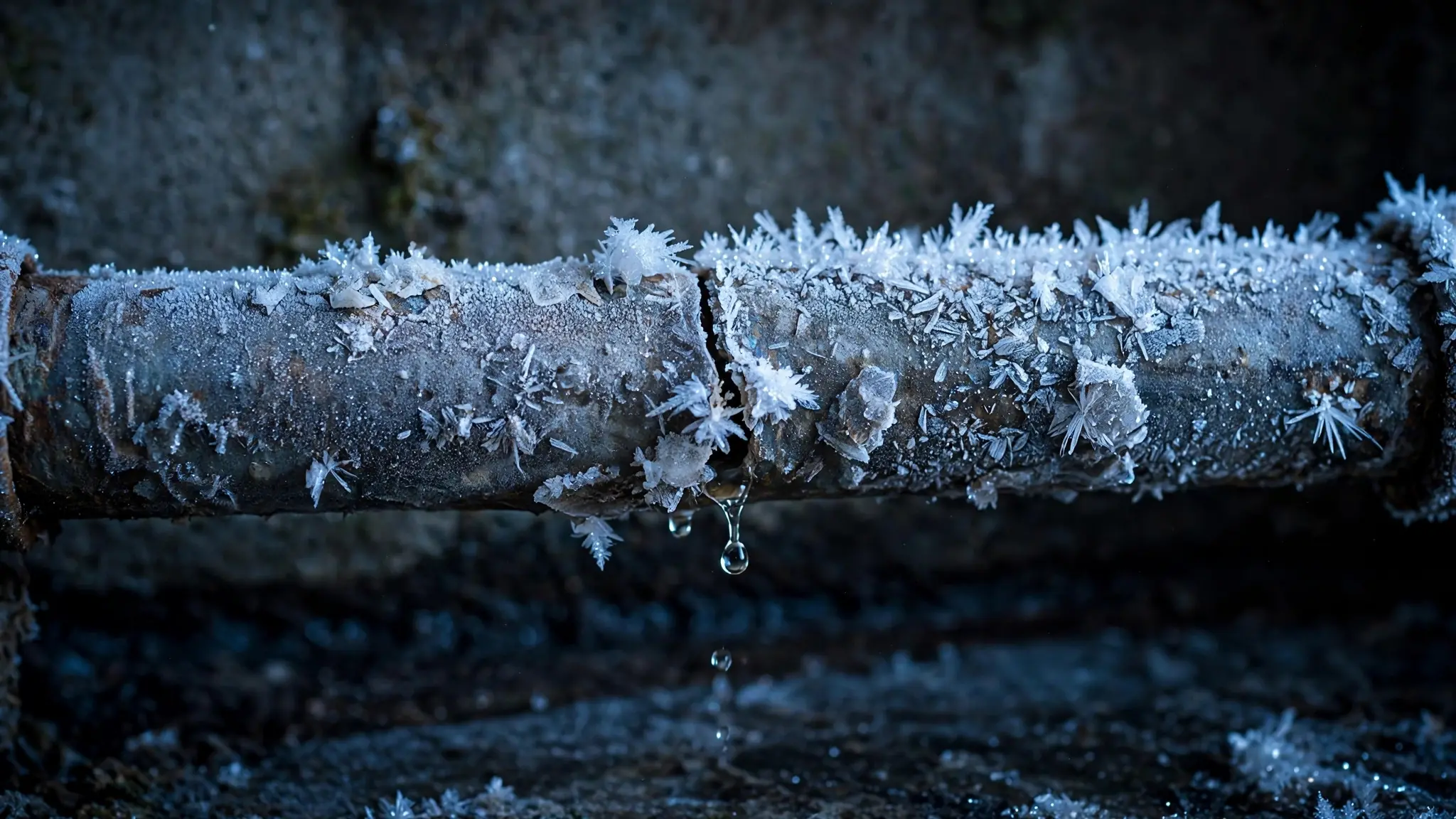
This is the clearest warning there is. If you can see frost or a white, crystalline coating on a pipe in your basement, crawl space, or garage, the water inside is at or near freezing — and ice expands with enough force to split copper, PEX, and PVC alike. Act immediately: open the faucet that pipe feeds to a slow drip to relieve pressure, warm the surrounding space, and apply gentle heat such as a warm towel or a hair dryer on low. Never use an open flame or a torch. If the faucet produces no water at all, the pipe may already be frozen solid — shut off the main valve as a precaution, because a thawed blockage can turn into a gushing burst in seconds.
2. Low or No Water Pressure After a Cold Night
You turn on the kitchen tap on a January morning and get a trickle — or nothing. Somewhere in the line, ice has formed and is choking off flow. The danger is not just the blockage; it is the pressure building up between the ice and the closed faucet, which is what actually splits the pipe wall. Leave the faucet open so pressure has somewhere to go, and start warming the likely frozen section. If pressure does not return as the house warms, do not just wait it out — a partially frozen pipe can burst hours after the first symptom. This is the sign most often ignored, and the one most often followed by a flood.
3. Strange Banging, Clanking, or Gurgling
Some pipe noise is normal — the tick of expansion as pipes warm and cool. The sounds to worry about are sudden and violent: loud banging or hammering when a faucet closes, or gurgling and whistling that starts after a cold night. Hammering suggests water hammer or pressure spikes; gurgling can mean ice is forming inside the line and water is forcing its way past it. If new noises appear during a cold snap, especially from walls or ceilings where you cannot see the pipe, treat it as an early alarm. Open the nearest faucet to relieve pressure and investigate before the noise becomes a rupture.
4. Foul or Musty Odors Near Drains and Walls
A musty smell that was not there last week can mean moisture is accumulating inside a wall cavity — from a pinhole leak, a sweating joint, or a slow split that has not fully opened yet. In winter, that slow leak can freeze, expand, and become a full burst. Do not mask the odor; find it. Check the wall or floor near the smell for discoloration, softness, or cool damp spots, and look in the basement or crawl space directly below. Slow leaks are also how mold gets a head start — our burst pipe mold remediation guide explains what happens when hidden moisture goes untreated.
5. Water Stains on Walls or Ceilings
A yellowish-brown stain spreading across a ceiling or down a wall is water telling on itself. The stain means a pipe above or behind that surface is leaking — and a leaking pipe in winter is a pipe under stress. The stain often appears well after the leak started, which means the surrounding material is already saturated. Do not just paint over it. Find the source, and if the pipe is in an exterior wall or unheated space, assume cold is involved. Stains that grow visibly over days are an urgent problem, not a cosmetic one.
6. Unusual Water Sounds When Nothing Is Running
Hearing water running, dripping, or hissing inside walls when every faucet is off is a red flag. It can mean a pipe has already developed a split and is leaking into a cavity — the burst has begun, just not where you can see it yet. Walk the house and listen at walls, especially exterior walls and the ceilings below bathrooms and kitchens. If you can localize the sound, shut off the water and call for help. This sign often shows up in homes on French Island and other areas with older plumbing runs — see our French Island burst pipe cleanup page for local guidance.
7. Cold Spots on Walls or Floors
Run your hand along exterior walls during a cold snap. A section that feels noticeably colder than the rest — or a cold stripe on a floor — can mark where cold air is reaching your plumbing through a draft, a missing insulation batt, or an unsealed penetration. That cold spot is where a pipe is most likely to freeze first. Seal the draft, add insulation, and keep the nearby faucet dripping during deep cold. Cold spots are the earliest, most preventable warning on this list — they tell you where the problem will start, before it starts.
What to Do When You Spot a Warning Sign
The pattern is the same for every sign: relieve pressure, add warmth, and do not wait. Open the affected faucet, warm the space, and address the draft or insulation gap. If a pipe has already split, skip straight to the emergency sequence — shut off the main valve and get professional help. Our emergency burst pipe cleanup crews are available 24/7 across the La Crosse area, because warning signs have a way of becoming emergencies at 2 a.m.
Frequently Asked Questions
My pipes make noise in winter — is that always dangerous?
Not always. Expansion ticking as pipes warm and cool is normal. The sounds to worry about are sudden, loud banging or hammering, and gurgling or whistling that starts after a cold night — those suggest pressure problems or ice forming inside the line.
What should I do if I see frost on my pipes?
Act immediately. Open the faucet that pipe feeds to a slow drip, warm the space around the pipe, and apply gentle heat like a warm towel or hair dryer on low. Do not use an open flame. If the faucet has no flow at all, the pipe may already be frozen solid — shut off the main valve as a precaution.
Can a pipe burst without freezing first?
Yes. Freezing is the most common cause in La Crosse, but corrosion, high water pressure, and physical damage can also split a pipe. The warning signs differ — rust-colored water and chronic leaks point to corrosion, while hammering points to pressure — but the emergency response is the same.
How quickly can a warning sign turn into a burst?
Faster than most homeowners expect. A pipe with a partial ice blockage can burst within hours as pressure builds behind the ice, especially when temperatures keep dropping overnight. Treat every warning sign as a same-day problem, not a next-week project.
Every burst we see had a warning — the only question is whether anyone acted on it. If you are seeing any of these signs right now, do not wait for the flood: call (608) 817-7864 and La Crosse Burst Pipe Cleanup will connect you with a local crew. And if the worst already happened, read about our emergency burst pipe cleanup service to know what happens next.